|
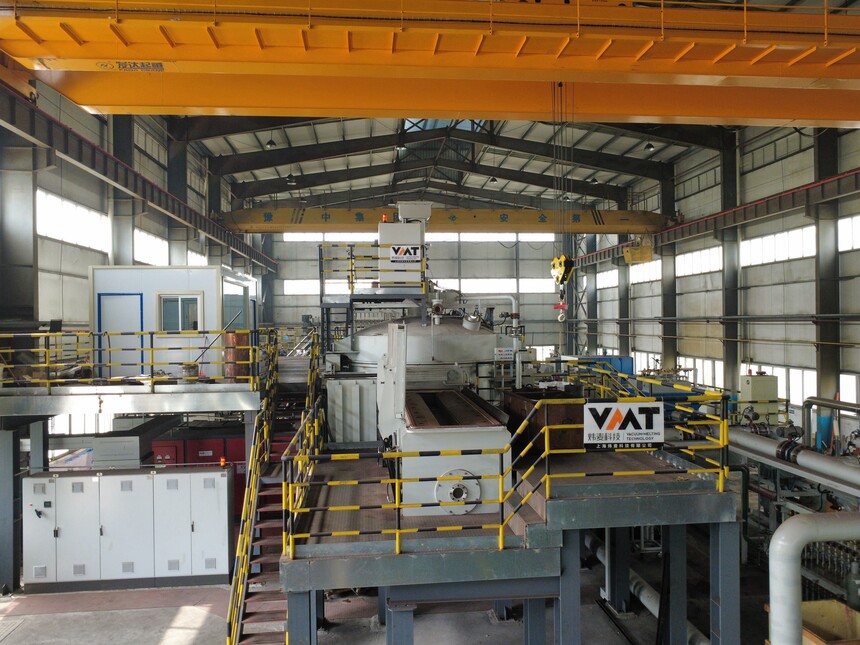
Complete Analysis of Vacuum Induction Melting Furnace Structure
In the manufacturing chain of high-end products such as aerospace engine blades and superalloy raw materials, vacuum induction melting is a critical process. As a complete set of metallurgical equipment that melts metals via electromagnetic induction heating in a vacuum environment, the Vacuum Induction Melting Furnace (VIM) generally consists of an upper charging chamber, melting chamber, side charging chamber, launder chamber, hydraulic system, ingot casting chamber, cooling water system, vacuum system, oil sump filter, and other components. Each unit has a clear structural function, jointly ensuring high-purity, high-precision, and high-stability operation of the melting process. The upper charging chamber is located at the top of the furnace body and separated from the melting chamber by an isolation valve. It allows preloading of various alloying elements without breaking the vacuum in the melting chamber. During melting, materials are fed in rotation according to the process sequence, enabling multi-batch secondary charging with low contamination. The side charging chamber is installed on the side of the melting chamber, usually complementing the upper charging chamber. It is used for feeding small-sized materials. The melting chamber features a double-layer water-cooled carbon steel shell with anti-sputtering treatment on the inner wall. An induction coil and crucible are installed inside. The furnace cover is equipped with ports for temperature measurement, sampling, charging, and observation windows. The melting chamber withstands high vacuum and completes metal melting, refining, and alloying once the coil is energized. The ingot casting chamber receives molten metal and completes solidification into ingots. Water-cooled copper molds or graphite molds are placed inside. In large-scale equipment, an isolation valve is installed between the ingot casting chamber and the melting chamber, allowing independent vacuum pumping or argon filling. The valve between the launder chamber and the melting chamber adopts a water-cooled structure, hydraulically driven and equipped with a valve compression mechanism. The launder chamber cover has a double-layer water-cooled wall made of carbon steel for both inner and outer walls, and is opened and closed by hydraulic drive. The launder chamber is usually equipped with an observation window and a heating device to prevent excessive cooling or solidification of molten metal during flow, ensuring smooth pouring. The hydraulic system provides power for mechanical movements such as furnace cover lifting, furnace tilting and pouring, and valve opening/closing. A typical configuration includes a hydraulic station, oil cylinders, pipelines, and control valve manifolds. The system pressure is generally 10–20 MPa. Main components of the cooling water system include a variable frequency power supply, induction furnace body, vacuum chamber, vacuum pumps, and vacuum valves. The induction furnace body and power supply have independent fully enclosed cooling circuits. Deionized water is used as circulating water to keep the induction coil and internal pipelines of the power supply clean, thus extending their service life. Vacuum SystemCreates and maintains a high vacuum environment inside the furnace. Typical configuration: mechanical pump + Roots pump + oil booster pump. Through valve combinations, the ultimate vacuum of the melting chamber can reach 5×10⁻³ Pa or higher. Oil Sump FilterA precision filtering device in the hydraulic system oil tank.Shanghai Vacuum Melting Technology Co., Ltd. has developed a new and unique oil filter sump for oil contaminants and particles entrained in airflow. It precipitates dust and fine particles in oil, reduces pollution to vacuum pumps, and lowers the risk of fire when handling flammable dust. Core Advantages of Weimai Vacuum Induction Melting Furnaces
Common Q&AQ1: What materials can be processed in a vacuum induction melting furnace?A1: Mainly used for producing high-purity, high-performance alloys. Key applicable materials include aerospace superalloys, precision alloys, titanium alloys, rare and precious metals, master alloys, electrode materials, etc. They meet stringent material requirements in aerospace, military, nuclear power, high-end manufacturing, and other fields. Q2: What vacuum level can be achieved?A2: With a three-stage vacuum system (mechanical pump + Roots pump + oil booster pump), the ultimate vacuum can reach ≤ 0.067 Pa, and the working vacuum is stably controlled at ≤ 5×10⁻³ Pa, ensuring material purity. Q3: What services are provided?A3: Full life cycle services including customized equipment design, on-site installation and commissioning, operation and maintenance training, remote O&M and fault diagnosis, key component replacement and maintenance, equipment relocation, and process optimization consulting, ensuring stable equipment operation throughout. Q4: Is the equipment safe?A4: The equipment is safe and reliable, fully compliant with international high-end metallurgical equipment safety standards. Enhanced core safety design includes: tight vacuum system sealing (leak rate ≤ 1×10⁻⁸ Pa·m³/s) to eliminate oxidation risks from air ingress; explosion-proof and leak-proof design for all electrical and hydraulic components; full-process safety interlocks enabling safe unattended operation. Safety of equipment, personnel, and production is fully guaranteed from design to operation. Q5: What projects have been completed?A5: 200 kg project for a large state-owned military enterprise; 6T project for an integrated iron and steel group; 20T project for a national high-tech enterprise, etc. |